Sollten Sie Ihre Solarmodule in Reihe oder parallel verdrahten?

Wenn Sie die Elektrik Ihres Wohnmobils oder Wohnmobils installieren, stehen Sie vor der Wahl, Ihre Solarmodule entweder in Reihe oder parallel miteinander zu verdrahten.
Jedes Setup hat Vor- und Nachteile, und Ihre Entscheidung hängt letztendlich von Ihrem Anwendungsfall ab. Aber die Serie ist in der Regel die bessere Wahl für die meisten DIY-Solarstrom-Setups für Wohnmobile. Wenn Sie eine größere Solaranlage haben, können Sie auch eine seriell-parallele Verdrahtung verwenden, um zusätzliche Vorteile zu erzielen.
Der wichtige Unterschied zwischen der Verdrahtung von Solarmodulen in Reihe oder parallel besteht darin, was mit der Spannung und dem Strom in jeder Konfiguration passiert. Bei der Reihenverdrahtung wird die Spannung erhöht, während der Strom gleich bleibt, während bei der parallelen Verdrahtung die Spannung gleich bleibt, während der Strom hinzugefügt wird.
Was bedeutet das und warum ist das wichtig? Dieser Artikel befasst sich mit den Antworten auf diese Fragen. Wir gehen auf die Vor- und Nachteile von Reihen- und Parallelschaltungen für Solarmodule für Transporter und Wohnmobile ein, schauen uns einige Beispiele und Anwendungsfälle an und sprechen darüber, was dies alles für die Gestaltung Ihrer netzunabhängigen Solar-PV-Anlage (Photovoltaik) bedeutet.
Fazit: Die Verkabelung Ihrer Solarmodule in Reihe oder parallel ist der richtige Weg für Solarsysteme für Wohnmobile und Wohnmobile. Da die Spannung bei der Reihenverdrahtung addiert wird, erreichen Ihre Solarmodule viel früher am Tag die Ladespannung, was bedeutet, dass Ihre Batterien schneller und länger aufgeladen werden. Auch die Reihenverdrahtung ist viel einfacher, da Sie keine zusätzlichen Verdrahtungsstecker oder Sicherungen benötigen.
Für größere Arrays (mindestens 400 W, besser mit 600 W oder mehr) können Sie eine seriell-parallele Verdrahtung verwenden, die die Spannungsvorteile der Reihenverdrahtung mit den Abschattungsvorteilen der parallelen Verdrahtung kombiniert.
Verdrahtung von Solarmodulen in Reihe
Um Ihre Solarmodule in Reihe zu verdrahten, verbinden Sie den Pluspol eines Moduls mit dem Minuspol des nächsten Moduls und so weiter. Bei dieser Verdrahtungsmethode wird eine sogenannte Reihe von Solarmodulen erstellt.
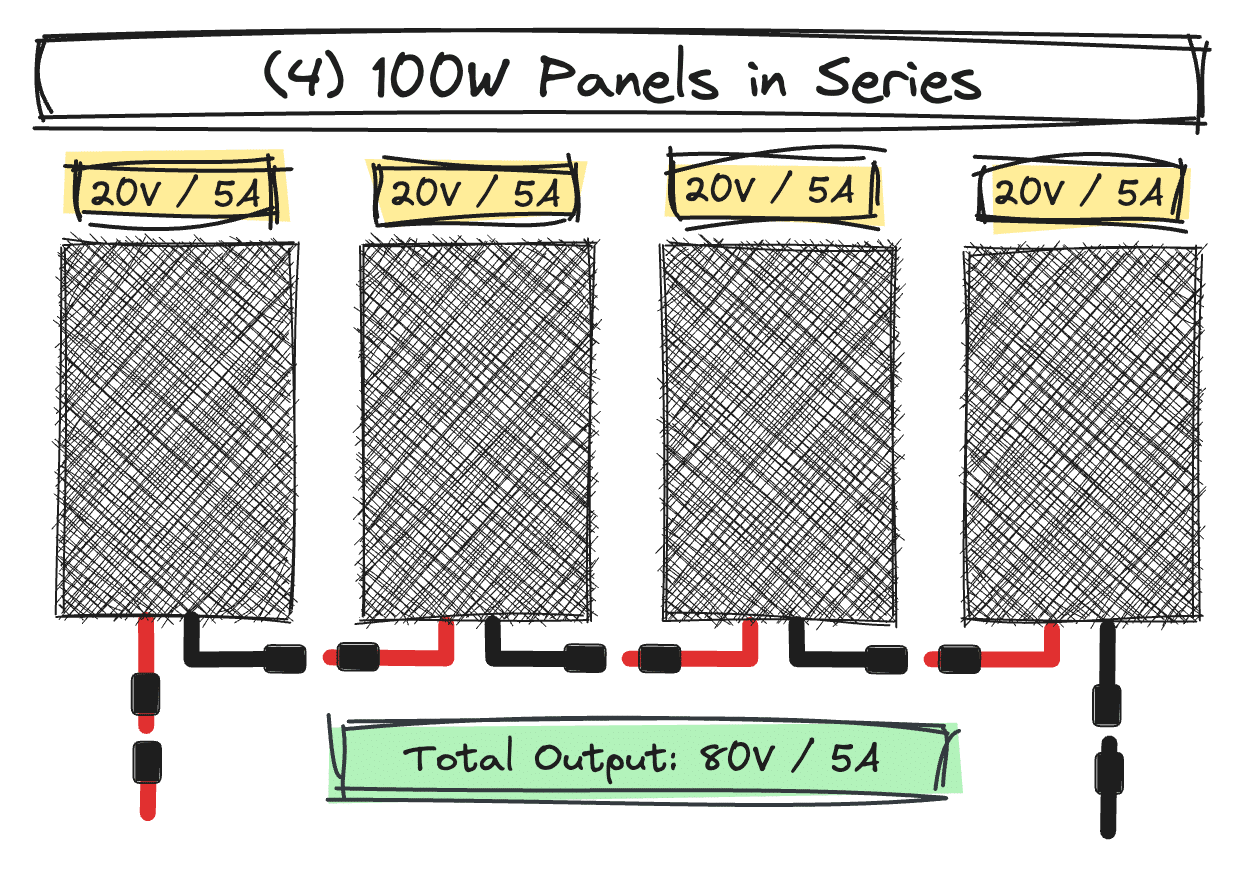
With series wiring, the voltage of the panels adds together while the amperage (current) stays the same.
Example: If you have four 100W solar panels wired in series and each panel outputs 5A at 20V, your array would output 5A at 80V (4 panels x 20V = 80V).
That 80V output is in full sun. At times of day when less sun is hitting your panels (early morning, late afternoon) or when there are clouds in the sky, the system output voltage will be substantially less.
Why does this matter? Your solar panel output voltage needs to exceed the charging voltage of your batteries before they can begin charging. Because Volts add with series wiring, the output of your PV array will hit that charging voltage much earlier in the day compared to a parallel system, and will continue charging for longer.
Where to Find the Voltage of Your Solar Panels
You have 12 Volt solar panels, so the voltage produced must be 12 Volts, right? Wrong.
12V is what’s called the nominal voltage, and is basically used for matching equipment and components together for compatibility. If you’re building a 12V electrical system, you’ll want a 12V battery bank, a 12V charge controller, 12V solar panels, and 12V inverter, for example.
The actual output voltage of your solar pv modules will be higher than the nominal voltage. 12V panels produce up to 18V-24V, depending on the panel. The figure out the maximum voltage for your specific PV panels, take a look at the open circuit voltage(voc). You can find the open circuit voltage on the specifications sticker on the back of most solar panels, in the manual, or on the manufacturer’s website.
Benefits of Series Wiring for Solar Panels
Wiring solar panels in series vs parallel has several benefits when it comes to setting up an efficient solar power system that will sustain you for life on the road.
- The major benefit to series wiring is the higher voltage it produces. Because of the higher voltage from the series connection, your batteries will ultimately charge earlier, faster, and longer. Your solar panels will be able to produce enough voltage even in poor light conditions from shade or suboptimal panel orientation towards the sun. And combined with an MPPT charge controller, this allows you to squeeze greater efficiency out of your solar panels.
- Series wiring produces less output current (Amps), meaning you can use smaller gauge wires to connect to your solar charge controller. 10AWG solar wire is usually all you’ll need.
- Series connections are a whole lot simpler (and cheaper) to implement. Because of the lower amperage output you usually don’t need solar fuses (although you should always double check your specific fusing requirements). You also won’t need any wiring connectors – just attach your solar panels together and you’re good to go.
Read More: When Do You Need to Fuse Solar Panels? (and how to do it)
Important Note: If you choose to wire your solar panels in series vs parallel, you need an MPPT charge controller. MPPT charge controllers can convert excess voltage to more current for faster/longer charging and higher efficiency. Less-efficient PWM charge controllers will simply drop excess voltage, meaning you’ll lose up to 30% of your solar output.
Drawbacks of Series Wiring for Solar Panels
There is one drawback to wiring solar panels in series vs parallel, and that’s how shade affects your solar output.
When you connect solar panels in series, the current must pass through all of the photovoltaic panels before it goes to the charge controller and into your battery bank. Just like with old school Christmas lights, if one panel goes out all the panels are affected. For example, if you’re in the woods and shade gets on just one panel, it cuts the power output of the entire solar panel system.
This power loss from shading is a major reason why some vanlife influencers and Youtubers may tell you to wire solar panels in parallel vs series. However, as we’ll discuss below, this isn’t as big of a deal as it may seem, and overall the benefits of series wiring far outweigh this drawback.
Wiring Solar Panels in Parallel
To wire your solar panels in parallel, connect all the positive terminals together then connect all the negative terminals together (using branch connectors or a combiner box).
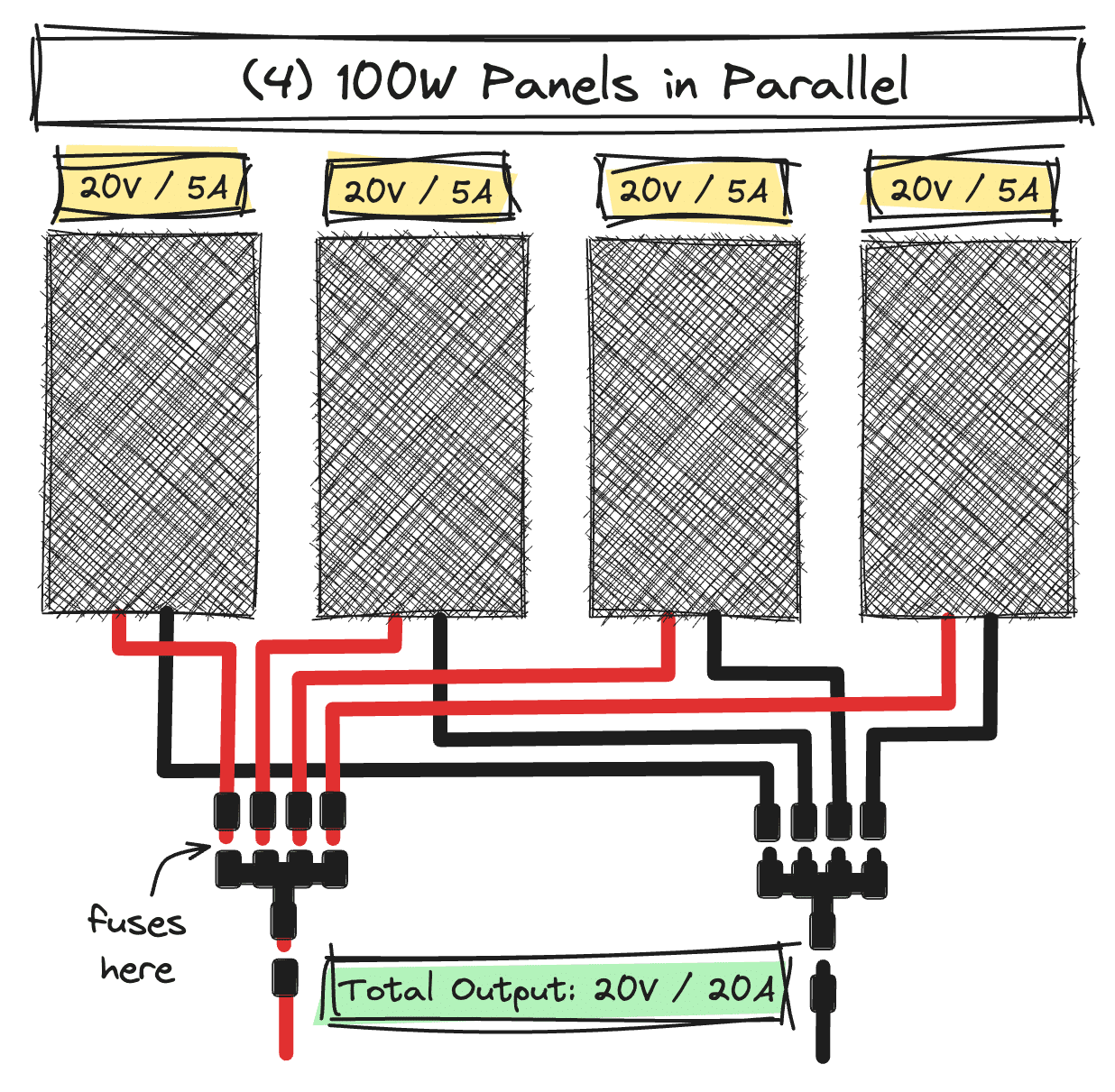
With parallel wiring, the amperage (current) adds together while the voltage stays the same.
Example: If you have four 100W solar panels wired in parallel and each panel outputs 5A at 20V, your array would output 20A at 20V (4 panels x 5A = 20A).
Again, that 20V output is in full sun and will be much less in the early morning and late afternoon when there’s less sunlight. This means that the voltage of your solar panel array will not reach charging voltage until much later in the day compared to series wiring, and it will drop back below charging voltage much sooner.
Drawbacks of Parallel Wiring for Solar Panels
Using a parallel solar panels connection has several significant drawbacks that make it a tough sell for most RV and campervan electrical systems.
- The major drawback to parallel connections for solar panels is the lower voltage. Your solar charge controller cannot charge your batteries until your solar array’s output voltage exceeds the charging voltage of your batteries. This means your batteries might not be meaningfully charging until close to high noon, and they’ll be charging for a shorter time period before the voltage input dips again later in the afternoon.
- Since you don’t have excess voltage to convert to current, you’re squandering the major benefit of MPPT charge controllers and losing out on significant efficiency increases by using a parallel connection.
- Installation is more complex. Because parallel solar panels output higher current, you likely will have to fuse your panels and may even need thicker solar wire. You will also need additional wiring connectors to combine your panels, all of which adds complexity, cost, and more potential failure points.
Benefits of Parallel Wiring for Solar Panels
The primary benefit to using a parallel connection is how shade affects your solar panels.
When you wire solar panels in parallel they are wired independently of each other. This means that shade on one panel has no effect on the others, which can be a big pro if you spend a lot of time in areas where there might be excessive shade.
Dies ist eher ein Vorteil, wenn es sich um stationäre Anlagen handelt, bei denen Ihre PV-Module nicht bewegt werden können, wie z. B. ein Tiny House oder eine netzunabhängige Hütte. Wenn Sie in einem bewaldeten Gebiet leben und die Verschattung um Ihre Photovoltaikanlage herum nicht kontrollieren können, ist eine parallele Verkabelung besser, da mehrere parallele Stränge Ihnen sicherlich helfen können, auch bei teilweiser Verschattung mehr Leistung zu erzielen.
Bei mobilen Installationen wie Wohnmobilen und Wohnmobilen überwiegen jedoch die Nachteile der Verwendung von Parallelverbindungen bei weitem diesen kleinen Vorteil, und es gibt viele Möglichkeiten, die Auswirkungen der Verschattung auf Ihre Paneele zu mildern (auf die wir weiter unten eingehen werden).
Verkabelung von Solarmodulen in Serie vs. parallel
Das Problem der Verschattung ist ein oft genannter Grund für die parallele oder serielle Verkabelung von Solarmodulen für Wohnmobile (und es ist wirklich der einzige Punkt, der für eine parallele Verkabelung spricht). Genau aus diesem Grund haben wir in unserem ersten Van Parallelschaltungen verwendet.
In der Praxis ist die Verschattung jedoch kein großes Problem, und die Vorteile der Reihenverdrahtung gegenüber der Parallelschaltung sind so groß, dass eine Parallelschaltung selten sinnvoll ist.
Wenn Sie Ihre Module parallel verkabeln, nur weil Sie möglicherweise Schatten auf einem Ihrer Module haben, behindern Sie Ihre Solarladefähigkeit, um für ein Szenario zu planen, das oft vermeidbar ist.
Finden Sie sich im Schatten geparkt? Bewegen Sie Ihren Van. Und bevor Sie Ihr Lager aufschlagen, denken Sie über eine mögliche Beschattung nach und wählen Sie Ihren Platz entsprechend aus. In der restlichen Zeit profitieren Sie von den erhöhten Ladevorteilen der höheren Spannung aus der Reihenverdrahtung.
Auch die Verschattung ist bei neueren 9BB-Solarmodulen weniger ein Problem, da die Beschattung im Allgemeinen nicht so stark beeinträchtigt wird. Bei Sonnenkollektoren reduziert selbst ein Schattenplatz die Leistung des gesamten Paneels in Watt. Bei 9BB-Solarmodulen ist dieser Effekt jedoch viel geringer, da der Strom mehr Wege hat, um den schattigen Bereich zu umgehen. Das bedeutet, dass selbst in einer Reihenkette eine kleine Menge Schatten oft keine große Sache ist.
Wann würden Sie also Solarmodule parallel verdrahten?
Es macht nicht viel Sinn, nur parallele Verbindungen zu verwenden, es sei denn, Sie haben ein kleineres PV-Array (200 W oder weniger) und verwenden einen PWM-Laderegler. Wenn Sie ein sehr knappes Budget haben und nur grundlegende Solarenergie für so wenig Geld wie möglich im Voraus benötigen, ist dieses kleine Niederspannungssystem eine der billigsten Optionen.
Für größere Arrays gibt es eine andere Verdrahtungsmethode, die als seriell-parallel bezeichnet wird und es Ihnen ermöglicht, die Vorteile von Reihen- und Parallelverbindungen in Kombination zu nutzen.
Wiring Solar Panels in Series-Parallel
To wire your solar panels in series-parallel, create separate strings of panels wired in series, then wire the strings together in parallel using wiring connectors.
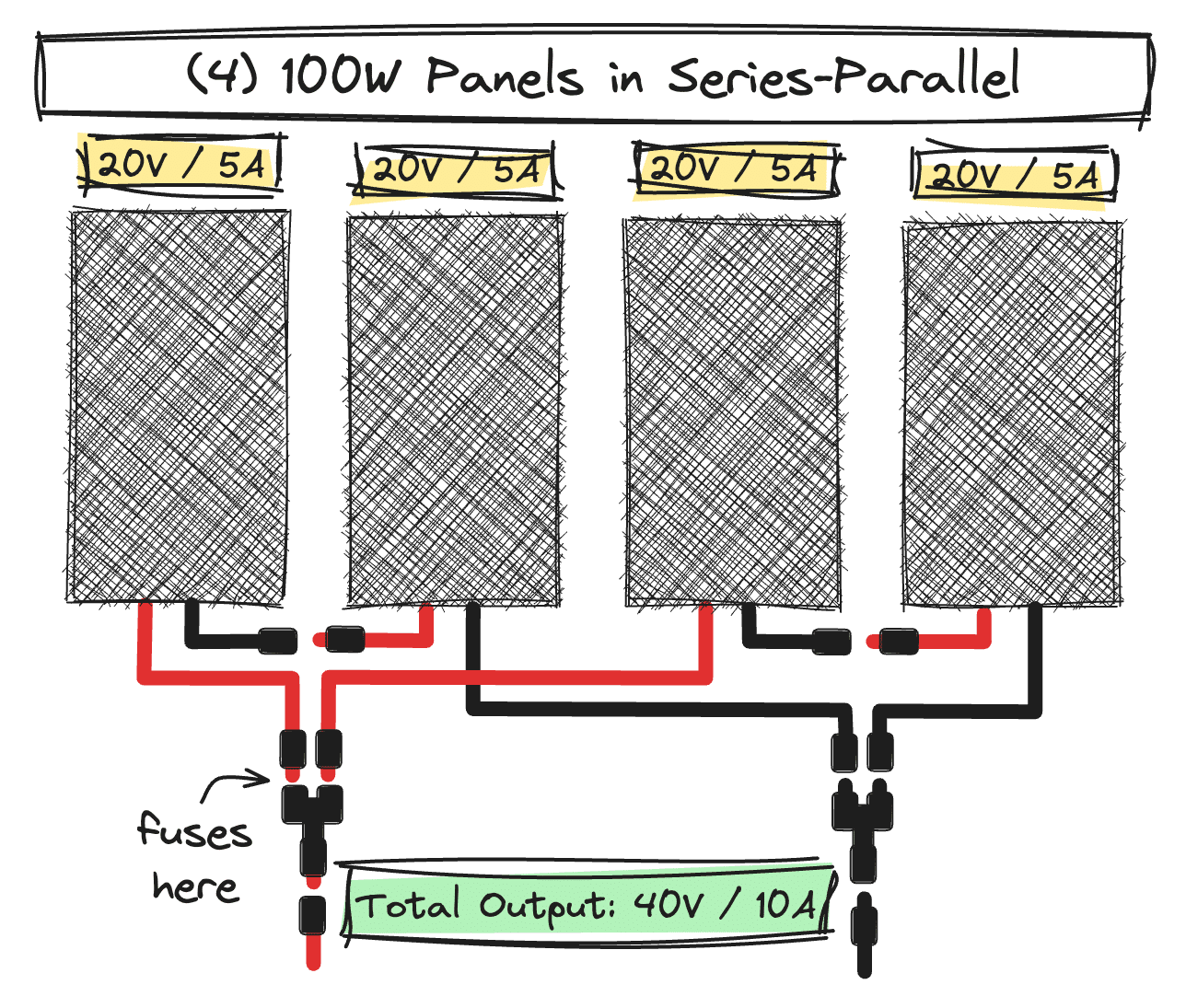
Bei einer Reihen-Parallel-Verbindung addieren sich die Spannungen der Panels in den Reihenstrings, dann addiert sich der Strom der beiden Strings in Parallelschaltung.
Beispiel: Wenn Sie vier 100-W-Solarmodule in Reihe geschaltet haben (zwei Reihenstränge mit 2 x 100 W Modulen, die parallel geschaltet sind) und jedes Modul 5 A bei 20 V ausgibt, würde Ihr Array 10 A bei 40 V ausgeben (Reihenkette aus 2 Modulen x 20 V = 40 V; 2 Stränge parallel x 5 A = 10 A).
Sie benötigen mindestens 400 W Solarenergie für eine Reihen-Parallel-Verbindung, und jeder String muss die gleiche Anzahl von Modulen haben. Um die Größe Ihrer Solaranlage zu erhöhen, können Sie entweder die Wattzahl Ihrer Serienstrings erhöhen (d. h. zwei Stränge mit 3 x 100 W Modulen) oder weitere Stränge hinzufügen (z. B. drei Stränge mit 2 x 100 W Modulen). Oder beides.
Persönlich würden wir bei Solarmodul-Arrays bis zu 400 W an der Reihe festhalten und in Betracht ziehen, ein Array in zwei seriell-parallele Strings für 600 W oder mehr aufzuteilen. Dadurch wird sichergestellt, dass die Array-Spannung hoch genug ist, um die Vorteile des Ladevorgangs wirklich zu nutzen.
Vorteile der seriell-parallelen Verdrahtung von Solarmodulen
Mit dieser Hybrid-Solarverkabelungskonfiguration erhalten Sie die Leistungsvorteile sowohl der seriellen als auch der parallelen Verkabelung.
- Die erhöhte Spannung aufgrund der Reihenstränge bedeutet, dass Ihre Batterien früher, schneller und länger aufgeladen werden und Sie Ihren MPPT-Laderegler ordnungsgemäß verwenden können.
- Sie können ein größeres Array aufbauen, ohne die Spannung zu stark zu erhöhen.
- Reduzierte Auswirkungen der Schattierung, da Sie über mehrere Zeichenfolgen verfügen, die nicht voneinander beeinflusst werden.
Nachteile der seriell-parallelen Verdrahtung von Solarmodulen
The primary drawback of series-parallel wiring is the increased complexity of planning and installing your camper solar energy system. You will need additional wiring connectors, and you will need to fuse each of your strings.
Series-parallel is also best used for larger setups. While you can employ series-parallel with as little as 400W of solar, the bigger benefits really kick in when you have 600W or more.
Important Note: If you’re thinking about using series-parallel wiring, make sure to review our recommendations for fusing solar panels. You will likely need to fuse every individual string of a series-parallel array at the positive wiring connector.
Series vs Parallel for Mismatched Solar Panels
While it’s ideal to use identical solar panels no matter the wiring method, sometimes that’s not an option. Maybe you’re expanding the capacity of an existing solar array and you can’t find exact matches for your original panels. Or maybe you just want to make use of random solar panels you already have laying around.
Luckily, it is possible to wire together different solar panel types that have mismatched sizes, different electrical ratings, or are from different manufacturers.
The key to deciding between parallel or series wiring for mixing panels lies in what happens to the voltage and current in each wiring scheme.
When you’re wiring mismatched solar panels in series, you want to use panels with the same current rating (or similar). Remember, for series wiring, output voltages add while current stays the same. So with mismatched panels, all the panel voltages would still add together, but the output current of the series string would be equal to the solar panel with the lowest current rating.
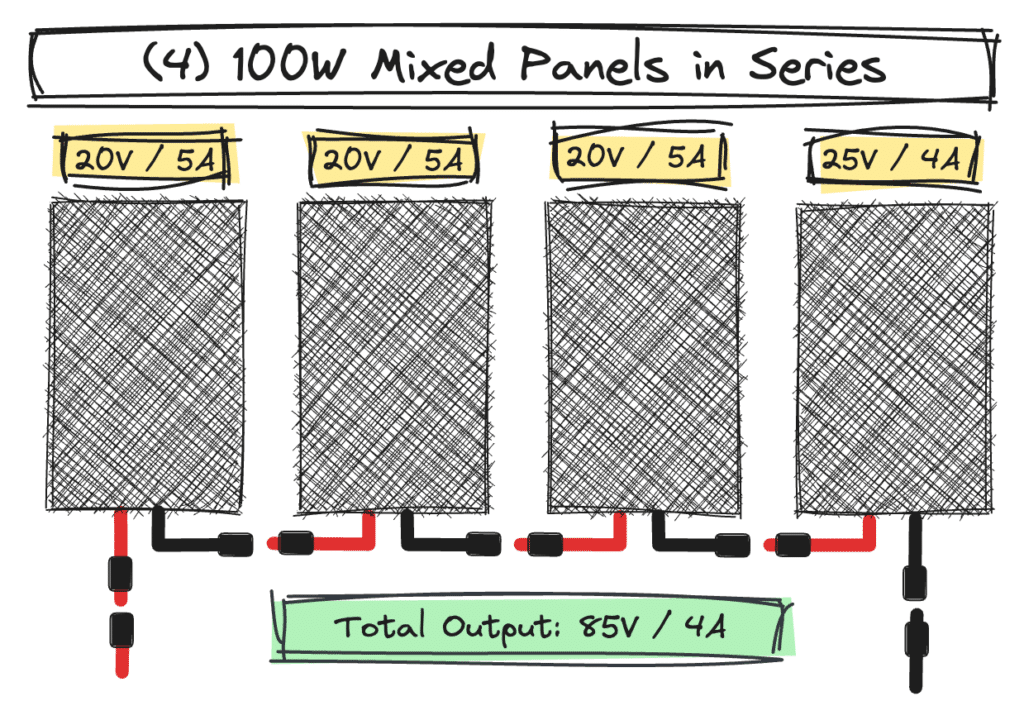
Example: You have four mismatched 100W solar panels wired in series. Three of the panels output 5A at 20V, while the fourth panel outputs 4A at 25V. The output of the entire array would be 4A at 85V (20V + 20V +20V + 25V = 85V. Lowest current rating = 4A).
Put another way, if you’re wiring together solar panels with a similar current rating but different voltages, we recommend parallel wiring vs series or series-parallel.
When you’re wiring mismatched solar panels in parallel, you want to use panels with the same voltage rating(or similar). Remember, for parallel wiring, Amps add while Volts stay the same. So with mismatched panels, all the amperages would still add together, but the output voltage of the array would be equal to the solar panel with the lowest voltage rating.
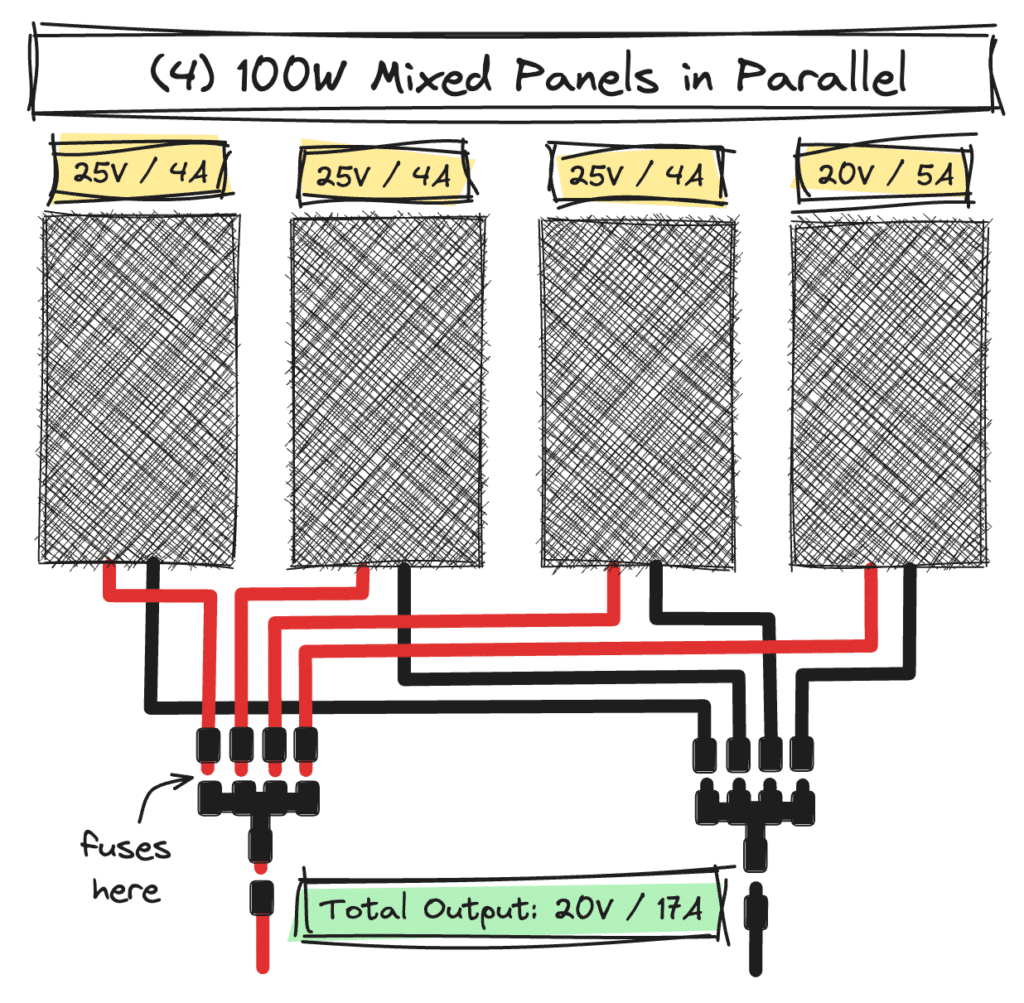
Example: You have four mismatched 100W solar panels wired in parallel. Three of the panels output 4A at 25V, while the fourth panel outputs 5A at 20V. The output of the entire array would be 17A at 20V (4A + 4A +4A + 5A = 17A. Lowest voltage = 20V).
So if you’re wiring solar panels with similar voltages but different current ratings, we recommend series wiring vs parallel.
The above guidelines can help you cobble together a solar system using multiple solar panels with different electrical ratings. However, if you’re expanding an existing system with different panels, consider wiring them to an additional solar controller instead. You’ll get the most out of your electrical system if all the same panels are feeding into each charge controller.
source : Sollten Sie Ihre Solarmodule in Reihe oder parallel verdrahten? (gnomadhome.com)